


reString Mailbag September 2026
Juan
We're back for another mailbag, where we answer questions from real customers.
This month, we will cover a reString Zero x reString Sync hybrid in the Yonex VCORE 95, a setup for a growing junior, cross tension with natural gut, a string for the Wilson Defyer 98 Pro, and choosing between reString Sync gauges.
Question 1 - Yonex VCORE 95 Hybrid
I'm playing with a Yonex VCORE 95 8th Gen.
I'm thinking on doing a poly poly hybrid, reString Zero and reString Sync. What kind of benefit should I see with this setup?
I'm currently using a full bed of reString Zero at 50 lbs.
I'm looking for a little bit more pump. Should I just drop the tension on the reString Zero string or go with the hybrid setup?
Any input would be helpful, thank you.
reString Response
A reString Zero and reString Sync hybrid is a really popular setup.
reString Zero in the mains gives you that spin and bite, while reString Sync in the crosses brings more control and a softer, more connected feel.
It is one of our most requested combos.
That said, since you are running a full bed of reString Zero and chasing more pop, the hybrid might pull you the other direction.
reString Sync leans more toward control than reString Zero, so swapping it into the crosses would likely soften the power a bit rather than add to it.
If more pump is the main goal, we would recommend starting by dropping your tension a couple of lbs on the full bed reString Zero setup you already have.
Our strings are built to resist elongation, so going a bit lower than your usual 50 lbs tends to open things up nicely without giving up much control.
From there, if you want to explore a different feel down the line, the hybrid is fun to try.

reString Zero
Best sellerOur flagship string. Designed to deliver maximum bite, explosive spin, and our signature long-lasting snapback, Zero lets players dominate the baseline with raw power and blistering pace.
Question 2 - Junior Player Setup
I am looking for string setup suggestions for my soon to be 14-year-old son.
He is lean, 5 ft 8 in, weighing 125 lbs, in the middle of a growth spurt.
He is switching to a HEAD Gravity MP racket now, from the Gravity Team he played with for a couple of years.
He is currently using Solinco Mach-10. He was using a multi before that and he was hitting long.
His body and game haven't developed enough to know what he needs or wants.
I am looking for a string setup for him, with these priorities, in this order:
- No injuries. He hasn't had any arm pain issues.
- To improve his all round technique and game. Since he is young he will adapt to the strings, so I am not necessarily looking for super easy power or spin.
- Consistent stringbed performance with good tension maintenance, so that he doesn't blame the racket or strings when he hits a bad shot. Ideally maintain playability till they break, since we don't know when to cut them off.
- Reasonable feedback on off center shots, so that he learns.
- We don't string ourselves. The cost of stringing is more than the cost of most strings, so I am not too sensitive to the string cost.
I am looking for suggestions for string setup and the tensions to go with.
Really appreciate any input. We don't have much of a tennis coaching culture around here.
reString Response
Given his priorities (arm safety first, room to keep developing technique, and consistent tension maintenance), we would point you toward reString Sync.
It is our round profile poly built for control and feel, and it holds its playability and tension longer than most polys out there, so it will not be fighting a dead stringbed.
For gauge, we would go with 17G / 1.25. It strikes a nice balance of comfort and durability for a growing player who does not need extra stiffness or power right now.
On tension, our general rule of thumb is to string about 2 lbs lower than a typical polyester setup, since our strings are engineered to move and snap back more than older generation polys.
If he was comfortable in the Mach-10 at a given tension, starting 2 lbs below that with reString Sync would be a good starting point, and from there it is really about fine tuning to feel.
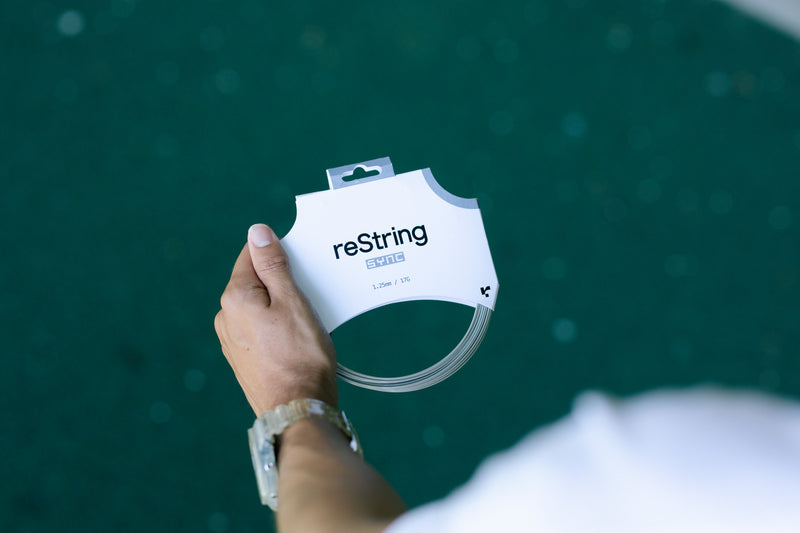
reString Sync
Best sellerIn full Sync with your game. Designed to deliver exceptional control, outstanding feel, and long-lasting snapback, and lets you maximize connection with every shot.
Question 3 - Natural Gut Cross Tension
I read somewhere that the recommended tension goes up to 55 lbs for reString Sync.
Is that true and is that a strict stop?
I was wanting to potentially put them in my crosses at 56 lbs.
Is that highly unadvised, or would it be close enough that it can work?
reString Response
56 lbs is okay. It is on the higher side, but not bad at all for reString Sync.
One question for you, are you planning a full bed of reString Sync, or just the crosses with gut in the mains?
If it is just the crosses, we would recommend going about 2 lbs lower than your mains, that will help you get some extra snapback out of the crosses.
Followup Question
Thanks! I'm doing natural gut in the mains at 57 lbs, and reString Sync at 53 lbs right now.
But I want to try 58/55 lbs next, and then potentially 59/56 lbs.
Is there a reason why you only recommend a 2 lbs difference?
Followup Response
Typically, in most hybrid setups, it's better to have the crosses a little bit looser than the mains to allow for greater string movement and pocketing, which helps with spin potential and overall comfort.
That differential is even more true since you're using a soft natural gut in the mains.
Keeping the reString Sync cross looser allows the gut to move around more and play better.
If you were to switch it and put reString Sync in the mains, you wouldn't really need to drop the cross tension as much because natural gut already plays so much softer by nature.
Question 4 - Wilson Defyer 98 Pro Setup
Hello, my son is a competitive junior player, probably going to play in college.
Has been playing with a Wilson Blade 98, now trying out the Wilson Defyer 98 Pro.
Is there one of your strings that you would recommend for that Defyer?
I know that's kind of a broad question, but is there one that you have found that tends to do well in that racket?
I think he feels the Defyer is a little more lively and powerful than the Blade, so he might be looking for a string that is a little more controlled.
Thanks for any thoughts you might have!
reString Response
Indeed, a lot of people have transitioned from the Blade to the Defyer in search of a bit more pop and power.
That said, coming from a more control-oriented racket like the Blade, the Defyer is definitely more lively and powerful.
Because of that, we've actually heard of a lot of people switching to reString Sync.
It's a great control-oriented string that gives you a ton of feel on the ball thanks to its formula and round, slick surface.
It'll definitely complement the more powerful characteristics of the Defyer to balance it out.
Another option is reString Vivo.
That one is also highly control-oriented and comes in a hexagonal shape, giving you more bite and spin potential on the ball.
This string plays a little firmer than reString Sync, which is ideal for high-level players.
We know a lot of collegiate players using this for its crisp feel and awesome tension maintenance.
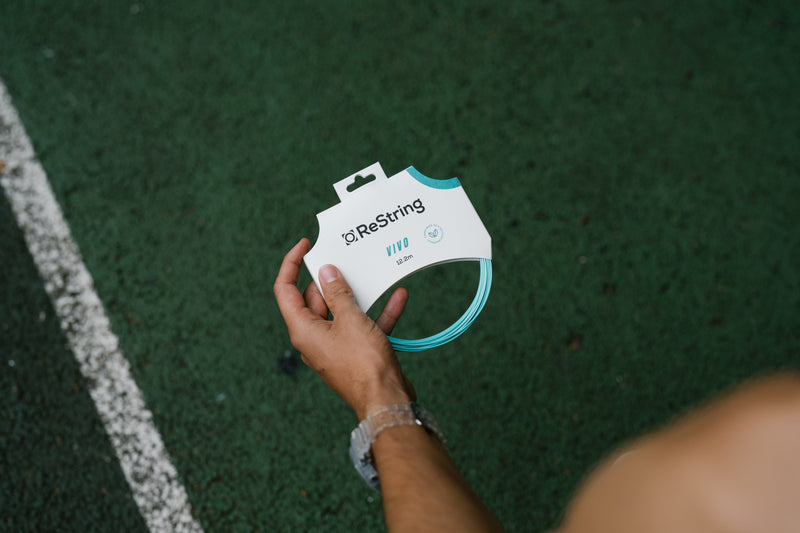
reString Vivo
New innovationAll out on performance. All in on sustainability. Offering exceptional control with a gripping bite, Vivo gives players the confidence to place every shot with precision and spin.
Question 5 - reString Sync Gauge Choice
I have the Wilson Defyer 98 Pro and want to try reString Sync with it.
Do you recommend using only 17G or only 18G reString Sync, or would it be helpful to run 17G on mains and 18G crosses or vice versa?
How much better tension maintenance does the 17G have over the 18G?
I never break strings so the durability difference isn't a concern for me.
reString Response
Since durability isn't a concern for you, this really comes down to feel and control preference.
17G will give you better tension maintenance and a slightly firmer, more controlled response, while 18G gives you more feel and a touch more spin since it's thinner and moves a bit more in the bed.
Running a hybrid, 17G mains with 18G crosses, is also a great way to go.
You'd get the extra tension stability where the string sees the most wear (the mains), while still getting that added feel from the thinner crosses.
Some players prefer it the other way around too, with 18G mains for more bite and 17G crosses for stability, so it really comes down to what you're looking to feel more of.
Since you don't break strings often, we'd say try a full bed of 17G first to get a baseline, then experiment with the hybrid from there if you want more feel.

String Finder
< 2 minsYou know your game, we know our strings. Answer a few quick questions about how you play, what you string with, what tension you string at, and we'll match you to the right string in the reString lineup.
Got Your Own Question?
We'd love to hear from you and share the best response we can to help your game.
If you have your own question, you can submit that via our contact page or on Instagram.
Until next month, enjoy your tennis!
Note: questions and responses have been lightly edited for easier reading.
